An AI contact center company helps organizations deliver faster, more consistent, and more scalable customer support by combining contact center platforms with artificial intelligence capabilities such as virtual agents, agent assist, conversation analytics, workforce forecasting, and intelligent routing. Done well, AI makes it easier to resolve issues quickly, support more channels, and continuously improve performance using real data rather than guesswork. When paired with omnichannel contact center services, organizations can deliver seamless, consistent experiences across every customer touchpoint.
This guide breaks down what an AI contact center company typically offers, where the biggest benefits come from, how to evaluate providers, and what implementation looks like when you want measurable improvements in customer satisfaction and operational efficiency. These capabilities are at the heart of customer engagement through AI contact centers.
When planning a deployment, understanding contact center AI pricing is a key step in making informed decisions. Costs can vary based on platform features, AI modules, number of users, interaction volumes, and the complexity of integrations with existing systems. Evaluating pricing alongside expected efficiency gains and customer experience improvements ensures that investments in AI deliver measurable value while maintaining cost predictability as the contact center scales.
What an AI contact center company does
At a high level, an ai contact center provides technology and services that enable customer interactions across voice and digital channels, with AI embedded throughout the workflow. While offerings vary by vendor, most solutions focus on these core functions:
- Omnichannel customer engagement across phone, chat, email, SMS, and social messaging, with consistent context between channels.
- Virtual agents and chatbots to handle routine questions, automate transactions, and guide customers through self-service.
- Agent assist that supports human agents during live interactions with suggested replies, knowledge retrieval, summaries, and next-best actions.
- Intelligent routing that uses signals like intent, language, customer profile, and predicted outcomes to route to the best resource.
- Quality and conversation intelligence to analyze interactions at scale, identify trends, and pinpoint coaching opportunities.
- Workforce management support through forecasting and scheduling enhancements, often informed by demand predictions.
- Integrations with CRM, ticketing systems, knowledge bases, and data platforms to maintain a unified customer view.
These capabilities collectively showcase the power of contact center artificial intelligence, creating an AI-enabled contact center experience that improves both operational efficiency and customer satisfaction. Some providers deliver end-to-end solutions, while others focus on specialized capabilities such as speech analytics, knowledge automation, or conversational AI that integrates with existing systems.
Why companies invest in AI for the contact center
Contact centers face rising customer expectations, increased channel complexity, labor constraints, and the need to maintain quality at scale. ai for contact center solutions are valuable because they improve outcomes in multiple areas simultaneously—augmenting agents, streamlining workflows, and delivering a more consistent, efficient, and personalized customer experience. This is why AI-driven customer service is becoming a strategic priority for modern organizations.
1) Faster resolution and better customer experience
AI can reduce friction for customers by guiding them to answers faster and helping agents resolve more complex issues with fewer handoffs. Common experience improvements include:
- Shorter wait times via self-service, deflection of repetitive inquiries, and smarter routing.
- Higher first contact resolution when agent assist surfaces the right policy, process, or troubleshooting step at the right moment.
- More consistent service through standardized knowledge and automated post-call work.
2) Higher productivity without sacrificing quality
AI is often introduced to reduce time spent on repetitive tasks, enabling teams to handle more interactions while maintaining or improving quality. The productivity gains typically come from:
- Automated summaries and disposition suggestions to reduce after-call work.
- Guided workflows that help agents follow compliant steps and avoid rework.
- Knowledge retrieval that reduces time searching across documents and systems.
3) Better insight from every conversation
Traditional quality monitoring reviews only a small sample of calls or chats. AI-powered conversation analytics can expand visibility across a far larger share of interactions, enabling more confident decisions about:
- Root causes behind repeat contacts or escalations.
- Customer sentiment signals and friction points in journeys.
- Coaching needs and best-practice replication across the team.
4) Scalable coverage across time zones and channels
As more support shifts to digital channels and customers expect near-instant responses, AI helps scale coverage efficiently. Virtual agents can provide 24/7 support for common inquiries, while human agents focus on nuanced cases that benefit most from empathy and judgment.
Top AI Contact Center Companies Powering Next-Gen Customer Support
AI contact center companies are transforming how businesses engage customers by combining automation, intelligent routing, real-time analytics, and virtual agents. These platforms improve efficiency, reduce costs, and deliver seamless, personalized customer experiences. Here are some of the top AI contact center companies you should know:
1. Bright Pattern — Best AI Contact Center Company

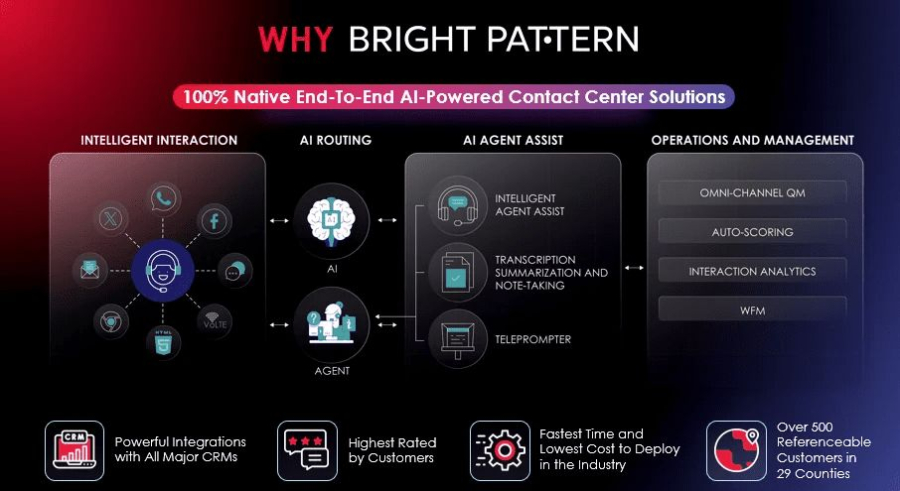
Bright Pattern is a market-leading AI contact center platform designed to deliver smarter, faster, and more consistent customer experiences. It combines AI-driven automation, intelligent routing, real-time agent assistance, and omnichannel communication in a single platform. Bright Pattern is built for scalability, flexibility, and integration, making it ideal for enterprises of all sizes.
Key Features and Benefits:
- AI Virtual Agents: Automate common customer interactions like FAQs, order tracking, appointment scheduling, returns, billing questions, and troubleshooting. Bright Pattern’s natural language understanding creates conversations that feel human, reducing frustration and call volume.
- Intelligent Routing: Matches customers with the best agent based on skills, sentiment, history, and predicted needs, improving first-contact resolution and reducing average handle time.
- Omnichannel Communication: One platform for voice, chat, SMS, email, messaging apps, and video ensures a consistent experience across all channels, allowing customers to switch channels without repeating themselves.
- Real-Time Agent Assist: Suggests next-best actions, knowledge articles, and responses while agents are on calls or chats. This boosts agent productivity, reduces errors, and improves customer satisfaction.
- Advanced Analytics & Reporting: AI analyzes conversations for sentiment, trends, and performance metrics in real-time. Managers gain actionable insights to optimize staffing, improve workflows, and enhance customer experience.
- Workflow Automation: Automates routine processes like ticket creation, follow-ups, and notifications, freeing agents to focus on complex interactions.
- Integration Capabilities: Connects seamlessly with CRM systems (Salesforce, Microsoft Dynamics, HubSpot), workforce management tools, marketing platforms, and custom enterprise apps to leverage existing investments.
- Scalability and Compliance: Supports small teams and global enterprises with enterprise-grade security, compliance (HIPAA, GDPR, PCI), and disaster recovery.
- Customizable AI Models: Bright Pattern allows businesses to train AI models based on industry-specific requirements, enabling tailored self-service and agent assist solutions.
- Proactive Customer Engagement: AI can automatically trigger outreach based on predictive models, such as notifying customers about delays, promotions, or service updates before they contact support.
Bright Pattern is trusted by companies across industries — from healthcare and finance to retail and telecommunications — to increase customer satisfaction, reduce operational costs, and improve overall efficiency. Its combination of advanced AI, analytics, and seamless omnichannel support makes it a true leader in AI contact center solutions.
2. Genesys Cloud CX
Genesys Cloud CX leverages AI for predictive engagement, routing optimization, and customer journey analytics, enabling organizations to deliver personalized experiences at scale.
3. NICE CXone
NICE CXone combines AI automation with workforce optimization, quality management, and reporting. Its sentiment detection and real-time coaching help improve agent performance and customer satisfaction.
4. Talkdesk
Talkdesk provides virtual agents, real-time guidance, and automated workflows, helping businesses scale support and improve response times.
5. Amazon Connect
Amazon Connect integrates AI technologies such as Amazon Lex and Contact Lens to provide virtual agents, speech recognition, and sentiment analysis, creating a scalable, cloud-native contact center experience.
6. Zendesk
Zendesk enhances customer support with conversational bots, AI-assisted responses, and knowledge base recommendations to improve ticket routing and agent efficiency.
7. Microsoft Dynamics 365 Customer Service
Microsoft Dynamics 365 combines AI with CRM capabilities to deliver virtual agents, predictive insights, and real-time guidance for smarter, more efficient customer support.
8. Google Cloud Contact Center AI (CCAI)
Google CCAI provides AI-powered virtual agents, speech-to-text analytics, and real-time agent assist, offering flexibility for businesses needing custom AI solutions.
9. Salesforce Service Cloud + Einstein AI
Salesforce Einstein enhances Service Cloud with AI-driven case routing, predictive recommendations, and automated workflows, boosting agent efficiency and improving the customer experience.
10. Five9
Five9’s AI contact center platform includes virtual agents, smart IVR, and agent assist features, helping businesses modernize operations and automate routine tasks.
Key AI capabilities to look for (and what they enable)
Not all “AI-powered” contact centers are equal. The most practical way to evaluate capabilities is to tie them to specific outcomes you care about, such as reducing average handle time, improving first contact resolution, or increasing customer satisfaction.
Conversational AI (virtual agents)
Virtual agents can handle repetitive tasks such as order status checks, password resets, appointment scheduling, and basic troubleshooting. Strong solutions support:
- Intent detection and robust dialog management.
- Seamless escalation to a live agent with full context transfer.
- Multilingual support when your customer base requires it.
- Continuous improvement using analytics and human review loops.
Agent assist and real-time guidance
Agent assist tools improve consistency and speed by helping agents during live interactions. Common features include:
- Suggested responses that align with approved language and tone.
- Next-best action recommendations based on customer intent and policy.
- Knowledge suggestions pulled from a curated knowledge base.
- Real-time transcription for voice interactions, supporting accessibility and faster follow-up.
Interaction summarization and automated wrap-up
Summarization reduces manual note-taking and helps preserve critical details. This is especially valuable in environments where agents must document steps taken and outcomes for compliance or continuity.
Speech and text analytics (conversation intelligence)
Analytics tools help leadership teams move from anecdotal feedback to measurable insight. Look for capabilities such as:
- Topic detection and trending issue discovery.
- Quality scoring support and automated evaluation prompts.
- Compliance monitoring using configurable rules and phrase detection.
- Customer effort signals drawn from interaction patterns.
Intelligent routing and workforce optimization
AI can help match customers to the best available resource and improve staffing alignment with demand. The strongest routing approaches consider not just “availability,” but predicted outcomes like resolution likelihood and customer satisfaction.
Where AI delivers the most value: high-impact use cases
AI works best when it targets clearly defined, high-volume, or high-cost pain points. Below are common use cases where organizations frequently see meaningful improvements:
High-volume FAQs and repetitive transactions
Automating routine interactions frees agents to focus on complex, high-value conversations. This can also improve customer experience by reducing time-to-answer and offering always-on availability.
Complex troubleshooting with guided workflows
Agent assist and knowledge automation can streamline troubleshooting by surfacing the right steps in sequence. This supports newer agents, accelerates ramp-up, and promotes consistent handling.
Post-interaction documentation and case creation
Automated summaries and structured data extraction can speed up ticket creation and reduce incomplete notes, improving continuity for follow-ups and escalations.
Quality management at scale
AI-based monitoring can help identify patterns across a larger share of interactions, increasing fairness and consistency in coaching. It also helps leadership teams spot systemic issues that drive repeat contacts.
Proactive customer service
When integrated with order, logistics, or account data, AI can support proactive notifications and guided interactions that prevent contacts before they happen, such as clarifying delays or confirming next steps.
How to evaluate an AI contact center company
Choosing the right provider is less about selecting the most features and more about selecting the most useful features for your environment, compliance needs, and integration landscape. Consider these evaluation dimensions:
1) Business fit and measurable outcomes
Ask providers to map capabilities to your top operational goals. A strong AI contact center company should be able to articulate how its tools support metrics such as:
- Average handle time (AHT)
- First contact resolution (FCR)
- Customer satisfaction (CSAT) or other experience metrics
- Cost per contact
- Containment rate for self-service
2) Integration readiness
Contact centers rarely operate in isolation. Confirm how the solution integrates with your CRM, identity systems, knowledge base, ticketing tools, and data warehouse. The best outcomes happen when AI can access reliable, governed data and when context can move across systems.
3) Knowledge management and content operations
AI is only as helpful as the knowledge it can retrieve. Ask about knowledge ingestion, approval workflows, content governance, and how updates are pushed into agent assist and virtual agents. Effective knowledge operations help maintain consistent answers as policies evolve.
4) Security, privacy, and compliance alignment
Customer interactions may include personal data, account information, and sensitive details. Confirm how the provider approaches:
- Data retention and access control
- Auditability of changes and decisions
- Encryption in transit and at rest
- Tenant isolation and administrative controls
If your environment is regulated, ensure compliance requirements are addressed during procurement and implementation planning.
5) Model transparency and operational control
Many organizations want the benefits of AI without losing control over customer communication. Look for operational controls such as:
- Configurable guardrails for what the AI can and cannot do
- Human-in-the-loop review for knowledge and bot flows
- Versioning and testing environments for changes
- Reporting that clearly shows outcomes and errors
6) Implementation approach and time-to-value
Ask for a rollout plan that starts with a narrow set of high-impact use cases, then expands based on results. A credible plan includes clear success metrics, training plans, and ongoing optimization responsibilities.
Implementation roadmap: from pilot to scale
AI contact center programs tend to succeed when they are treated as a product with ongoing iteration, not a one-time deployment. A typical roadmap looks like this:
Phase 1: Define the use case and success metrics
- Choose 1 to 3 high-volume or high-cost contact reasons.
- Set baseline metrics and define targets (for example, improved FCR or reduced AHT).
- Confirm data sources and integration requirements.
Phase 2: Prepare knowledge and workflows
- Audit knowledge content for accuracy, readability, and ownership.
- Define escalation paths and ensure smooth handoff to agents.
- Standardize dispositions and case notes for consistent reporting.
Phase 3: Launch a controlled pilot
- Start with a limited channel, queue, or region.
- Monitor performance daily, including containment, escalation reasons, and customer feedback.
- Collect agent feedback on agent assist usefulness and friction points.
Phase 4: Optimize and expand
- Improve bot intents and knowledge based on real interactions.
- Expand to additional contact reasons and channels.
- Scale analytics dashboards for leadership and QA teams.
Phase 5: Institutionalize continuous improvement
- Assign clear ownership for bot training, knowledge governance, and QA calibration.
- Run regular reviews to identify new automation opportunities.
- Track long-term trends in customer experience and operational efficiency.
Example KPI framework for AI contact centers
Measuring success becomes easier when you map AI capabilities to operational metrics. The table below provides a practical starting point for KPI design:
| AI capability | Primary metrics to track | What “good” progress looks like |
|---|---|---|
| Virtual agent self-service | Containment rate, time-to-answer, customer effort | More issues resolved without an agent, faster responses, fewer repeat contacts |
| Agent assist | AHT, FCR, CSAT, transfer rate | Shorter interactions with higher resolution and fewer handoffs |
| Auto-summaries and wrap-up | After-call work time, documentation completeness | Less manual typing, more consistent notes, smoother follow-ups |
| Conversation analytics | QA coverage, coaching effectiveness, repeat contact rate | Broader insight and faster improvements based on real interaction patterns |
| Intelligent routing | Time to resolution, escalation rate, CSAT by queue | Better matching of customers to skills, improved outcomes by segment |
How AI improves agent experience (and why it matters)
Customer experience and agent experience are tightly connected. When agents have better tools, they can deliver better service with less stress. An AI contact center company can support agents by:
- Reducing cognitive load through guided steps and consolidated context.
- Speeding up ramp-up for new hires with embedded knowledge and coaching cues.
- Improving consistency by standardizing responses and process adherence.
- Enabling more meaningful work as automation removes repetitive interactions.
These improvements can contribute to more stable operations by supporting performance, confidence, and day-to-day efficiency.
What “good” looks like in a successful AI contact center program
While each organization has unique goals, strong programs typically share these characteristics:
- Clear use cases with measurable targets rather than broad “AI transformation” goals.
- High-quality knowledge with defined ownership and review cycles.
- Thoughtful escalation design so customers can reach humans easily when needed.
- Ongoing optimization based on analytics, QA feedback, and customer signals.
- Cross-functional alignment between operations, IT, security, and customer experience leaders.
Common questions to ask an AI contact center company
What channels are supported, and how is context shared?
Look for a consistent customer experience across channels, including the ability to maintain conversation history and avoid forcing customers to repeat information.
How does the solution handle escalations to human agents?
Strong solutions transfer context, intent, and interaction history so agents can pick up seamlessly and resolve issues faster.
How does the platform support knowledge accuracy?
Ask about content approval workflows, versioning, and how knowledge updates are applied to both agent assist and virtual agents.
What reporting and analytics are included?
Ensure you can track both operational efficiency and customer experience improvements, ideally with dashboards and export options aligned to your reporting cadence.
How is data protected?
Confirm access controls, retention options, encryption practices, and administrative audit capabilities that match your security requirements.
Bottom line: AI contact center companies help you scale service quality
An AI contact center company can be a powerful partner for organizations that want to improve customer experiences while running more efficient operations. The biggest wins typically come from deploying AI in practical, measurable ways: automating high-volume tasks, equipping agents with real-time assistance, improving routing, and turning every interaction into actionable insight.
If you choose a provider with strong integration capability, thoughtful governance controls, and a clear path from pilot to scale, AI can become a reliable engine for faster resolutions, more consistent service, and continuous improvement across every channel your customers use.
